
RainPoint Programmable Sprinkler Timer Review
This affordable 2-zone hose timer brings flexible scheduling to two hoses at once

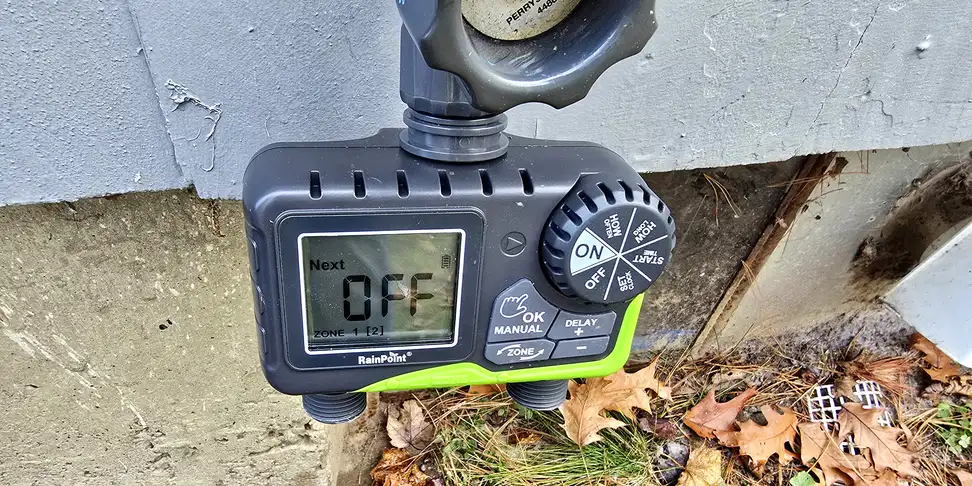
If you have a lawn or garden, you need to water it. And if you’ve had to water it by hand, you’ve probably thought, “Man, I wish I didn’t have to do this myself.” That’s where the RainPoint Programmable Sprinkler Timer (available at Walmart) comes into play. This is a straightforward, easy-to-use timer that lets you use one faucet and connect two hoses to run water wherever you need it, when you want, for as long as you want. Each of its two zones gets its own schedule, so you can give your vegetable garden short, frequent drinks while a sprinkler on the other zone gives the lawn a long soak once a week. Setup takes about 15 minutes, and once it's programmed, it turns on and off right on schedule. At around $60, it's also a fraction of the price of smart irrigation controllers. It has its quirks: There's no app or weather-based scheduling, so you'll need to set a rain delay yourself, and its plastic threads call for a gentle hand when you attach hoses. But for a simple solution to your home watering needs, it’s an excellent time-saver.
-
About the RainPoint 2-Zone Water Timer
-
How we tested
-
What we like
-
What we don't like
-
Warranty
-
Should you buy the RainPoint 2-Zone Water Timer?
-
Related content
Pros
-
Two independent zones
-
Wide scheduling range
-
Easy dial setup
-
Rain delay
-
IP65 weather resistance
Cons
-
No app or weather sensing
-
Shared water pressure
-
Plastic threads
About the RainPoint 2-Zone Water Timer
- Type: Battery-powered 2-zone hose faucet timer
- Model: ITV205
- Zones: 2 outlets, each with its own start time, duration, and frequency
- Watering duration: 1 minute to 3 hours 59 minutes per zone
- Watering frequency: Every 1 to 12 hours, or every 1 to 7 days
- Rain delay: 24, 48, or 72 hours
- Manual watering: Zone 1, Zone 2, or both at once
- Water pressure: 7 to 116 psi (0.5 to 8 bar)
- Maximum flow: About 35 liters (9 gallons) per minute
- Faucet connection: Standard 3/4-inch garden hose thread with a 360-degree rotating inlet
- Power: 2 AA alkaline batteries (not included), with a low-battery warning and automatic valve shutoff when power runs low
- Weather resistance: IP65 rating
- Operating temperature: 37 to 122 degrees F, cold water only
- Price: $59.99 list on RainPoint's site; varies by retailer
RainPoint is one of the most common names in budget hose timers, and it sells several similar two-zone models with different inlet materials, displays, and smart features. This version is the non-connected one, which puts it up against simple dial-and-screen timers on the market. That lack of smart connectivity is the main differentiator between timers in this price range and those that cost significantly more, but you get a lot for your money with two separate programmable zones, durations ranging from minutes to hours, and the ability to program a watering schedule and add a delay when you need it.
How we tested
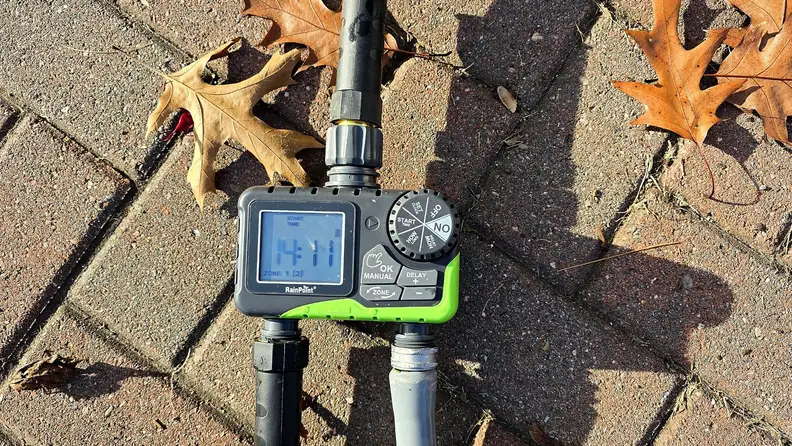
Each outlet runs on its own schedule, so two hoses can get two different watering programs.
To put the RainPoint to the test, I hooked it up to my outside faucet in New England with two sprinklers on separate zones. I tested it at the tail end of the watering season, which meant the RainPoint had to contend with a wide variety of temperatures and humidity levels. I tested how effectively it distributed water between its two zones, its ability to turn on and off on schedule, its ability to shut off even with water flowing through, and how accurately it adhered to the timer and frequency settings on the device itself.
What we like
Its scheduling range covers almost any watering job
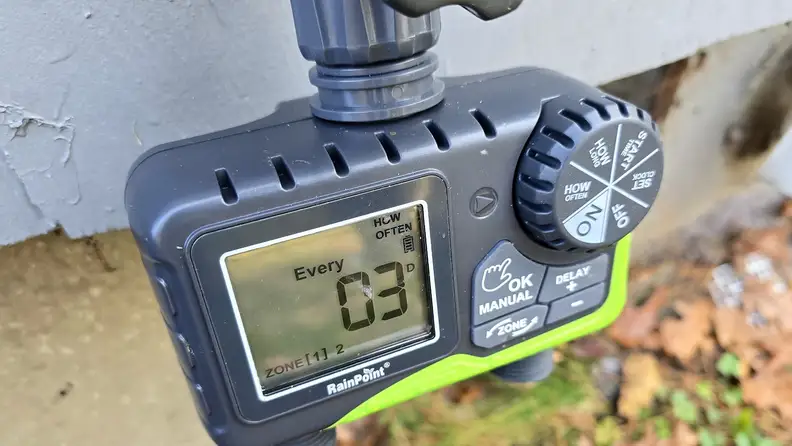
Zone 1 and Zone 2 each get their own frequency, so a garden bed and a lawn don’t have to share a schedule.
RainPoint's biggest advantage over similarly priced timers is the breadth of its scheduling options. Each zone can run as often as every hour or as rarely as once a week, for one minute up to nearly four hours. That means one zone can run short, frequent cycles for seedlings or containers while the other zone can get a full lawn-soaking deluge if necessary.
This makes the ITV205 suitable for a wide range of setups, including drip installations, greenhouses, or combinations where you have containers on one zone and a full sprinkler on the other.
That's the most critical part here: You can use it for any kind of setup you want. At my house, I have fertilization and overseeding periods when I need one watering schedule, but I also have containers and vegetable gardens for the rest of the season. The flexibility to have one timer that works for both needs—and even at the same time if I just need one hose per zone—makes this an attractive solution.
The design makes setting it up a breeze
Setting the RainPoint up takes about 15 minutes total, with a level of complexity on par with setting your alarm clock each day. You manually set the current time, then turn the dial to set each zone's start time, duration, and how often you want it to run. If you only want one zone, set the other zone's How Long setting to 00:00 to turn it off, and just twist the switch when you're done.
The screen rotates through the information you need, including the current time and when the next watering is scheduled for each zone. It makes it easy to understand what the timer is about to do so you know it was set right without having to watch it. In our testing, it handled every situation perfectly, didn't leak, and shut the water off from a full flow to zero drips in the snap of a finger.
It's built to handle a full season outdoors
The timer carries an IP65 rating, which means it should withstand outdoor use and remain hooked up through spring, summer, and fall. The model we tested seems ready for the usual range of elements, and in my testing it did just fine in temperatures ranging from the high 30s to the high 70s Fahrenheit, including direct sunlight.
The minimum rated temperature is still above freezing, though, and I wouldn't risk leaving this out for the winter, especially while it's in operation. Since the inlet and outlet threads are all plastic on the model I tested, I doubt it would react well to freeze-thaw cycles.
What we don't like
There's no app or weather-based scheduling
This is a fully manual timer, so you set everything directly on the unit. You can't check or change a schedule from your phone, and it won't skip watering based on the forecast. We've all driven by the neighbor whose irrigation system is going off in the middle of a rainstorm, and, sorry to say, that might be you with this timer.
That water running from your house costs money, so this can be a bit of a bummer if you don't (or can't) head out and program in a weather-related delay. The timer does support a rain delay of 24, 48, or 72 hours for both zones, so when you know rain is coming, you can easily have it skip a few days, but you need to plan ahead.
Running both zones at once splits your water pressure
Because both outlets draw from the same faucet, running them simultaneously divides the available pressure between them. RainPoint's own manual notes this. If you're running sprinklers or long hoses on both zones, you'll get better results by staggering the start times so each zone runs on its own—which, luckily, is easy to do with this timer. Just plan for it, and this is a non-issue.
Plastic threads could pose long-term problems
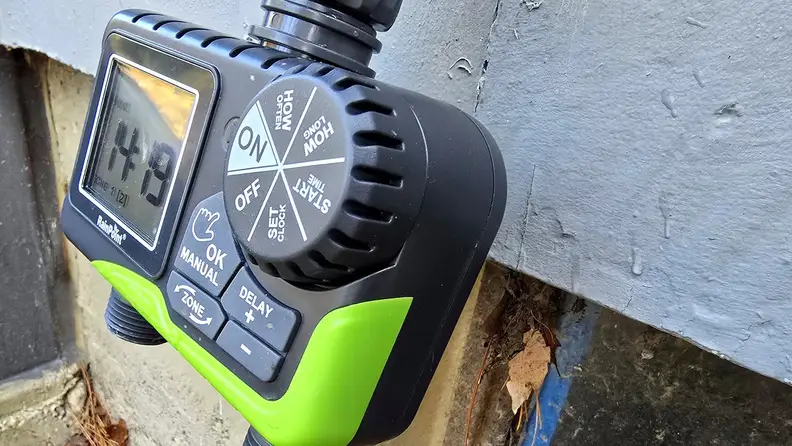
The timer’s inlet and outlet threads are plastic, so it’s worth going slowly when attaching it to a faucet or hose.
Maybe I'm a klutz, or I just don't know my own strength, but I struggle to avoid jumping threads when using a plastic hose connector. Especially when one side is brass, and the other is plastic, it's far too easy to strip the threads and create leaks. I also have hard water, which causes all sorts of issues, with fittings clogging up with deposits.
As a result, I wouldn't bank on this lasting years if you aren't careful with it. I would take care attaching and detaching hoses; go slowly, and don't overtighten connections. Some versions of this timer have brass connection points, so shop around if you're concerned about this. In my testing, the connections stayed leak-free once things were hooked up, but a leak is bound to happen eventually. But at around $35, it's not costly to replace every handful of years.
Warranty
The RainPoint ITV205 comes with a card in the box that claims a three-year warranty, but according to RainPoint's warranty page, it includes one year of coverage out of the box and requires registration to get the full three years of limited coverage. That coverage includes defects in materials and workmanship and has the usual caveats against misuse or unauthorized repair; see the page for the full details.
Should you buy the RainPoint 2-Zone Water Timer?
Yes, if you want a simple timer that can handle two different watering jobs
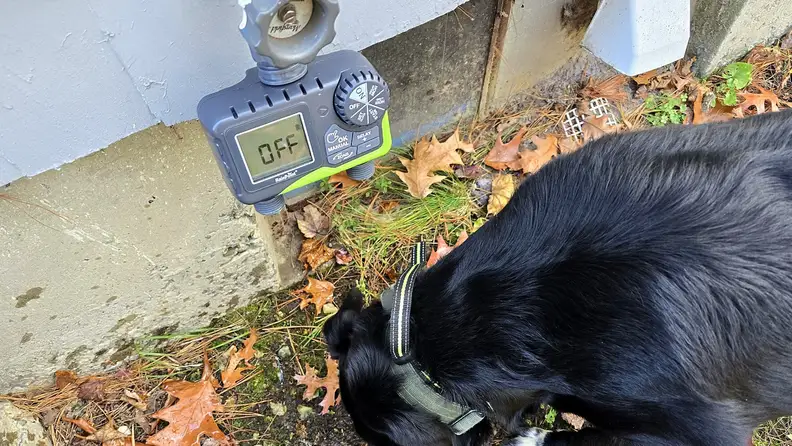
Once it’s programmed, the timer can run on its own through the watering season.
If you've done any overseeding, gardening, or landscaping around your home, you've inevitably run into the need for an automated watering system. Being able to guarantee your home gets water—and enough of it—at the right times is critical to having healthy plants or a lush, green lawn.
The RainPoint ITV205 (available at Walmart) helps you accomplish that with its simple, weather-resistant design and ability to set up two completely different watering schedules across its two zones. The controls are easy to pick up, and the device works exactly as intended once set up. The timer turned on and off, running for the set times with no trouble at all.
As with all timers, be cautious when connecting it to hoses—overtightening can cause a leak, since your faucet has to stay on for the timer to work. But if you can get it set up the way you want, this is a reliable, low-effort solution to keeping your lawn and garden watered and happy. It's even a good pick if you only need a single zone, since you can turn off a single zone by setting its duration to 0. You can use it as a single-zone timer for now and add the second zone only when necessary.
It's not perfect—and the lack of wireless connectivity means delaying due to weather requires a trip to hit the button—but for the price, it does the job well. You'll still want to make sure you've got the best hoses and the best sprinklers to get full coverage, and you'll need to test your setup to figure out exactly how long to water to get the result you want. But if you can put up with that initial setup, the RainPoint can keep your yard watered without interference all spring, summer, and fall.
Related content

 feature

Meet the tester

TJ is the former Director of Content Development at Reviewed. He is a Massachusetts native and has covered electronics, cameras, TVs, smartphones, parenting, and more for Reviewed. He is from the self-styled "Cranberry Capitol of the World," which is, in fact, a real thing.
Checking our work.
Our team is here to help you buy the best stuff and love what you own. Our writers, editors, and experts obsess over the products we cover to make sure you're confident and satisfied. Have a different opinion about something we recommend? Email us and we'll compare notes.
Shoot us an email