Do You Know How an LED Works?
LEDs light up the world and do so much for you. Get to know this loyal servant.
 Credit:

Products are chosen independently by our editors. Purchases made through our links may earn us a commission.
Excerpt
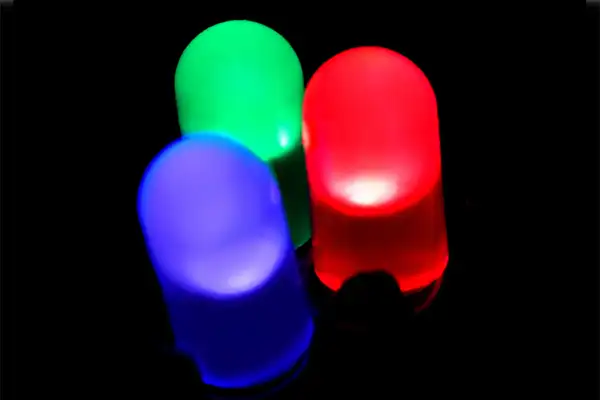
You’re probably familiar with the light-emitting diode (LED) as the light source that isn’t a flame, Edison bulb, fluorescent tube, or firefly (yes, there are more too, of course). Besides being responsible for so many inventions we love: displays, remote controls, high-speed internet, and (green) traffic lights, the LED has been getting increased press from new usages for household lighting, bendable screens, and extremely thin televisions. As their name suggests, the LED is a special type of diode. So how do they work?
Um, diode?
A diode is an electrical component made from semi-conductive material that only allows current flow in one direction. This is very useful for inventions like radio, which use the diode’s restrictive property to remove (rectify) one side of a radio wave, preventing the wave’s top and bottom from canceling each other out. This produces the electric pulse that drives an earphone. But while LEDs can work as rectifying diodes, they’re usually used as a light source.
What’s the difference between LEDs and Edison bulbs?
Despite their visual similarity to the incandescent Tom Edison-style light, LEDs and incandescent light bulbs work in two completely different ways. Incandescent bulbs use electric current to heat up a tiny filament to white-hot temperatures, casting off a great deal of light. But since much of the energy is given off as heat, the incandescent bulb isn’t very efficient.
Instead of giving off light due to heat, LEDs electroluminesce. Electroluminescence works by having a material with a difference in charge toward each end of the diode. On one side of the LED, the semi-conducting material is treated or “doped” so it has more electrons. The other side has been doped so it has fewer electrons—resulting in holes where electrons can go. When current is applied, the high-energy electrons from one side of the diode drop into the low-energy holes on the other side, requiring them to release energy. This energy release occurs in the form of light emission, like a sumo wrestler sighing as he sits into a comfy chair.
But how is that different from fluorescent light?
At a glance, LEDs and fluorescent lamps appear to work in the same way: current goes in through a substance and it glows. But fluorescent lights don't just give off light that easily. Instead of directly emitting visible light, the light released by fluorescent lamp's gas is actually ultraviolet light, which we can't see. So that light is directed at a coating around the lamp that converts the invisible UV light into the visible spectrum via a process called “fluorescence”—when a substance receives light and emits it at a lower wavelength.
What’s the future of LEDs?
As with most electronic components, there’s always a push for improved efficiency and smaller size and cost. With new technology, many electrical components can literally be printed and the young field of nanotechnology will doubtless shake things up for electronics, allowing for some new, crazy inventions. But these days, we’re mostly seeing LED light bulbs begin to steal some of the home-lighting market share from CFLs and incandescents. While they’re pricey, they’re really efficient, dim well, and are supposed to last longer.
However, the most glamourous cutting edge of LED technology definitely comes from the OLED (organic-LED) display, which uses organic molecules as semiconductors, rather than doped silicon. “Organic” here has a very specific meaning and has nothing to do with an origin in living organisms, or being grown on a pesticides-free farm just outside of Portland. Instead it refers to chemicals comprised primarily of the elements carbon, nitrogen, oxygen, and hydrogen, elements that are important to organic processes.
While the basic material is quite different from regular LEDs, the principle of OLEDs is identical. On the one side is a high-energy electron generator, on the other a low-energy electron acceptor. The light emitted from the relaxation of the electron is converted using dye molecules that absorb light at one wavelength and emit at another, allowing for any color of OLED light desired. The main advantage of OLEDs is their potential for being really small. In theory, they can be as thin as two molecules, which is orders of magnitudes smaller than the thinness achievable from silicon based LEDs. When you see thin flexible screens and cardboard thin televisions with unbelievably deep blacks, you’ll probably have LEDs to thank.
Photos: By PiccoloNamek CC-BY-SA-3.0, By Arnoldius CC-BY-SA-3.0, By outlaw_wolf CC-BY-SA-2.0, By Hannes Grobe CC-BY-SA-2.5, By Morcheeba CC-BY-SA-2.5, Reviewed.com


