
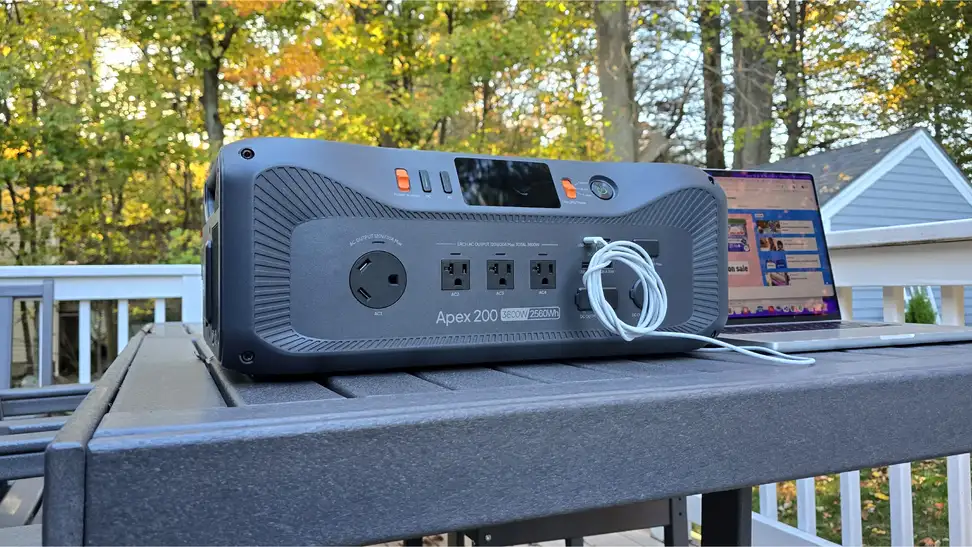
Bluetti Apex 200 Power Station Review
The Bluetti Apex 200 is a flexible backup power station for outages, camping, and even van life

If you're in the market for a battery backup power station that plays nicely with a variety of charging methods, it's hard to beat the Bluetti Apex 200 Power Station (available at Bluetti Power) . With 2,560 watt-hours of capacity and the ability to accept a range of charging inputs—from your wall outlet to solar panels—the Apex 200 is about as flexible as you could ask for. And because you can combine it with multiple additional batteries, the Apex 200 could be a great backup power solution, whether you want to get off the grid, power gadgets while RVing, or have a plug-and-play home backup in case of emergency.
-
About the Bluetti Apex 200 Power Station
-
How we tested
-
What we like
-
What we don't like
-
Warranty
-
Should you buy the Bluetti Apex 200 Power Station?
-
Related content
Pros
-
Easy to use
-
Long-lasting backup power
-
Connects easily to solar
-
Adding accessories can expand its usability
Cons
-
Heavy to carry
-
Doesn't have a 240V output
-
Can't power an entire home for days at a time
About the Bluetti Apex 200 Power Station
- Battery capacity: 2,560Wh LiFePO4 (51.2V/50Ah)
- AC output: 3,200W continuous standalone; up to 3,600W with an expansion battery or active AC/solar input (120V only, no 240V)
- Surge: 3,840–4,800W for up to 10 seconds (standalone)
- Outlets (10 total): 3x NEMA 5-20R (120V/20A), 1x TT-30R RV outlet, 2x USB-C (100W + 140W), 2x USB-A (15W each), 1x 12V/10A car outlet, 1x 12V/30A Anderson port
- Solar input: 3,000W total: 2,000W high-voltage MC4 (60–280V, 16A max) + 1,000W XT60 (12–60V, 25A max)
- AC charging: 1,800W with the included 15A cable; up to 3,200W with optional TT-30 or NEMA 14-50 cables
- Charge times (Bluetti testing): AC about 46 minutes to 80% and 1.6 hours to full at 3.2kW; solar about 50 minutes to 80% and 1.7 hours to full at 3kW (times depend on solar input and conditions)
- Vehicle charging: Up to about 1kW with Charger 2 (sold separately); up to 196W from a 24V car outlet
- Expansion: Up to six B300K (2,764.8Wh) or B500K (5,120Wh) batteries; 33.28kWh max with six B500Ks
- Parallel: Up to three units via Hub A1 for 6,000W and 99.84kWh (120V only)
- UPS: 15ms or less switchover (enable in the app)
- Smart features: Four app-controllable AC outlets (remote on/off, schedules, battery-level rules), time-of-use charging, Severe Weather Alert auto-charging, Alexa/Google Home/Home Assistant support
- Size and weight: 20.87 x 12.83 x 8.31 inches (36.5L); about 59.5 pounds (27kg)
- Noise: 50dB max
- Standby draw: 10.5W
- Operating temperature: Charging 32°F to 104°F; discharging -4°F to 104°F
- Ingress rating: IP20 (not water-resistant)
The Bluetti Apex 200 is one of several power stations the company offers, and it's slightly more compact than its larger lineup mate, the Apex 300. It has a relatively wide footprint but is shorter, and you can stack it alongside multiple power stations if you choose.
The main draw of the Apex 200 is its flexibility. You can use it as a standalone unit that stores power and distributes it through multiple outlets you can control via the app, or as part of a larger system with optional extras like a charger that draws power from your vehicle's alternator, solar panels, or up to six expansion batteries. You can build the system exactly the way you want and even connect three such systems.
How we tested
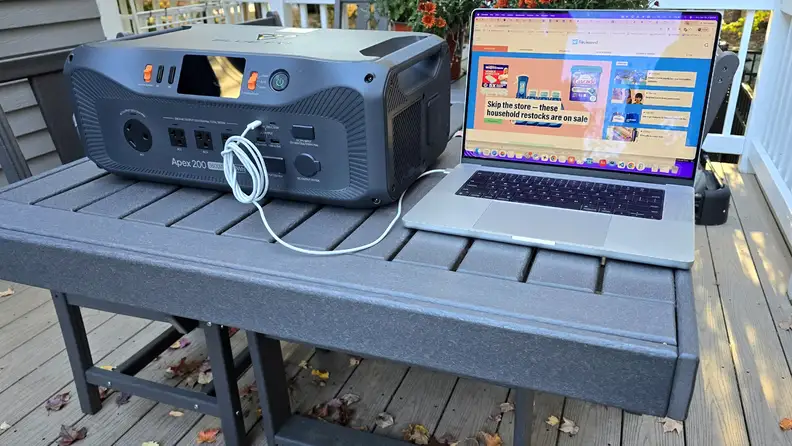
Everyday gear like a laptop was plugged straight into the Apex 200 to see how it handles a simulated outage.
To put the Apex 200 through its paces, I used it for two weeks in multiple scenarios, including as a deliberate emergency backup power source for my fridge, TV, laptop, and smartphone. I also used it to store power from one of Bluetti's Sora 500W fold-out solar panel arrays to test the realism of its charging claims. I tested some of the more exotic charging scenarios, along with how long it takes to top off from a typical wall outlet and whether that's a worthwhile choice.
What we like
As a backup solution, it's simple to set up and start charging
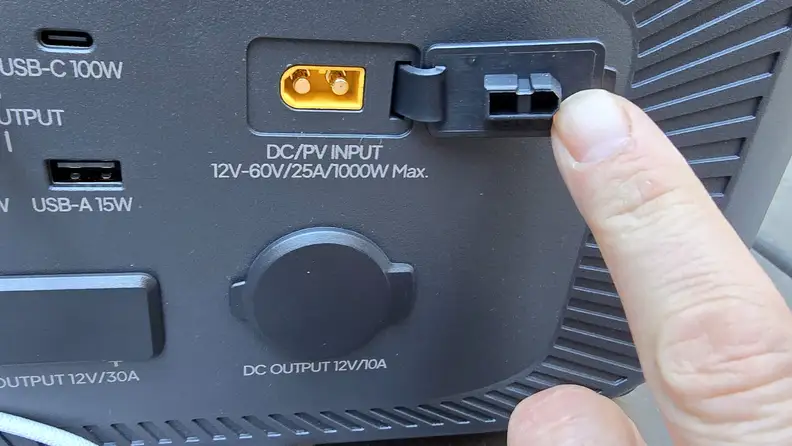
Dedicated labels on the inputs and outputs make it hard to plug something into the wrong spot.
Fundamentally, the Apex 200 is a big old battery you can plug other stuff into. While that's simplistic, it's the easiest way to think about it. You charge it up, it stores that energy, and then you use it when you need it.
And while it offers many features and support for complex, custom charging arrangements, setup couldn't be simpler. You plug it in, turn it on, and plug things into it when you want power. There's also an app for monitoring it when you're not nearby, and it's easy to use. All the outlets are clearly labeled, including whether they're input or output, which is helpful, though most outlets only work one way anyway.
Overall, if you know nothing about using a backup power source, this is as simple as it gets—with far less fuss (and danger) than a portable propane or gas generator might give you.
It delivers power when you need it, and for a long time
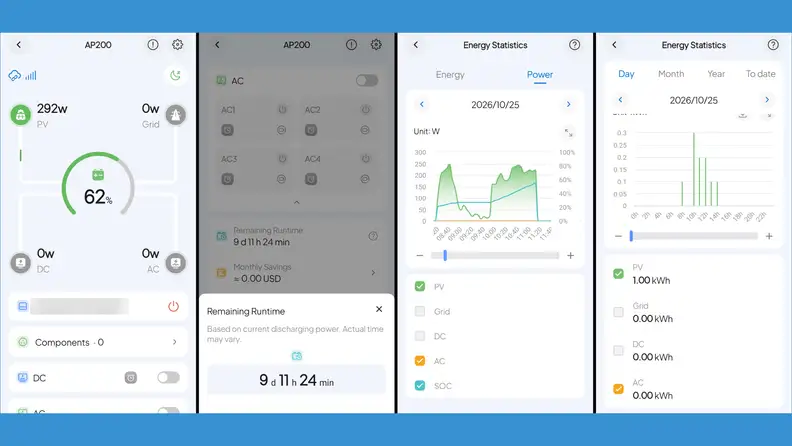
The app tracks charge level, solar input, and estimated runtime, so you can see how long your power will last.
The Apex 200 has 2,560Wh of battery capacity. That means if you have it charged to 100% and a bunch of devices drawing 2,560 watts, you could run them for one hour. Now, that's a lot of power—and in most scenarios, you'd use much less. Your typical high-end refrigerator's load will change as you use it, but you can get a rough idea by looking at its energy guide sticker like this one. This Maytag uses 750kWh per year, so divide that by 365 and you'll get a good idea of how much capacity it uses in a typical day. In this case, it's a hair over 2kWh, so the Apex 200 can keep it running at normal usage for more than 24 hours.
For lower-wattage devices that aren't constantly on, like your phone or laptop, you'll get far more use out of them. You could charge your typical phone more than 100 times on a power station like this.
The easy connection to solar power is a big plus
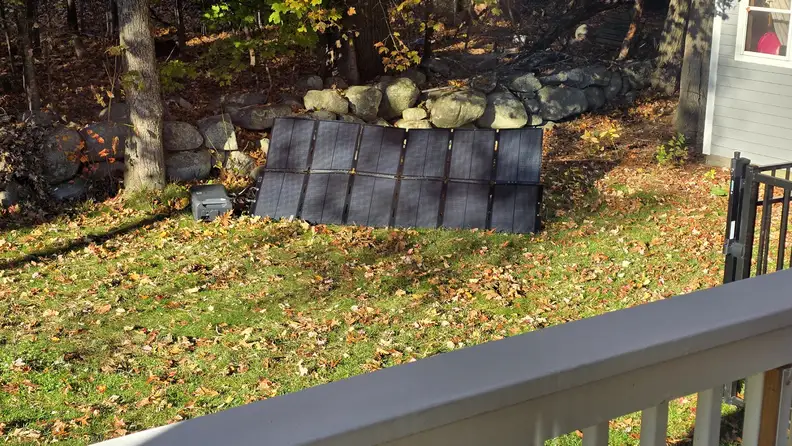
A fold-out panel and a patch of sun turn the Apex 200 into a free-charging backup, even in the shoulder season.
While you can always plug the Apex 200 into the wall and charge it up, you're still paying market rates for every bit of that electricity—you're just storing it for later. That could be cheaper in some rare circumstances, but solar power is the more economical choice.
Bluetti offers an excellent fold-out 500W solar panel charger that works well with the Apex 200. I tested them side by side (literally, the cables are that short), and it topped off most of the power station for free just by sitting in the sun. While this review isn't about the solar panel directly, this is the setup that I think makes the best use of it. Solar charging is highly location- and condition-dependent. On a bright summer day in Florida, you'll see close to that 500W max, but in October in New England, I topped out at 270W for an hour, with an average closer to 190W—and that included moving it around. I was still able to charge about 50% in six hours using just the sun.
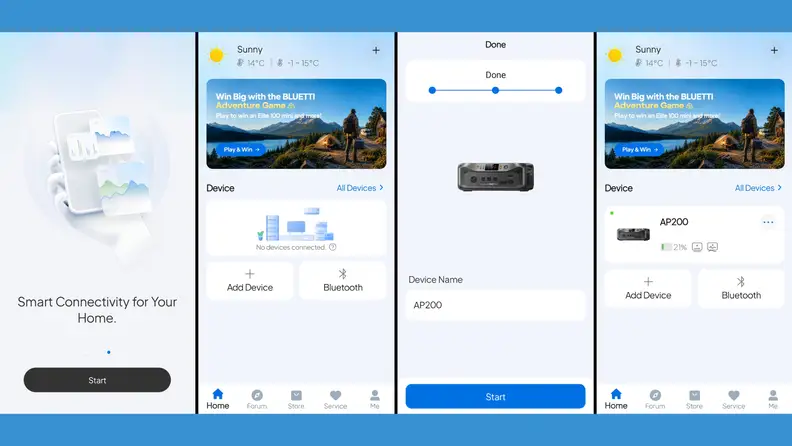
Once the Apex 200 is paired with the Bluetti app, its charge level shows up on the home screen, so you can watch it fill as solar power comes in.
You aren't going to save a ton of money charging via solar—with my electricity rates, it costs about 50 cents to charge the Apex 200 fully from the wall, versus free from the sun—but the flexibility is what makes it appealing. Even if you aren't a full off-the-grid convert, we're talking more than 2kWh of capacity that you can bring with you and top off whenever you get a good bit of sunshine. That's cool.
With enough accessories, it can be whatever you need it to be
Look online at people who use Bluetti's other power stations, and you'll see a wide range of use cases: cabins off the grid, occasional tailgates, RVs, people who use one as a home energy storage solution to charge their EV, and people living a full-on van life with converted camper vans.
The Apex 200 supports this many use cases by being compatible with a broad range of accessories. We haven't tested them all, and they're not cheap, but you have a load of options, and owners speak highly of the lineup's flexibility and durability.
For starters, if you want more capacity, the Apex 200 can connect to up to six B300K or B500K backup batteries. This lets you extend the 2.6kWh storage to more than 30kWh through one Apex 200 unit with B500Ks (just under 20kWh with B300Ks). The units even stack, so you can securely keep the Apex 200 with that extra capacity in one (seriously heavy) tower of power.
Charging that much capacity is challenging, so Bluetti offers options. You can plug it straight into a wall outlet with the included cable and charge from the grid—with optional campground-compatible plugs as well. Or you can use Bluetti's Charger 1 or Charger 2 to connect it to your vehicle. The main difference is that Charger 1 requires you to "cable shuffle" if you have a solar panel setup and need to switch to vehicle power, while Charger 2 is larger and can have both hooked up at the same time—it draws power from solar and your vehicle whenever they're available.
If you need far more capacity, you can also chain multiple setups like this together. Bluetti makes a product called the Hub A1 that lets you connect three Apex 200s, supporting 6kW of output and around 100kWh of storage if you kit each out with six B500Ks—enough to power even my power-hungry home as normal for multiple days without touching the grid.
What we don't like
It's heavy to lug around, so plan ahead
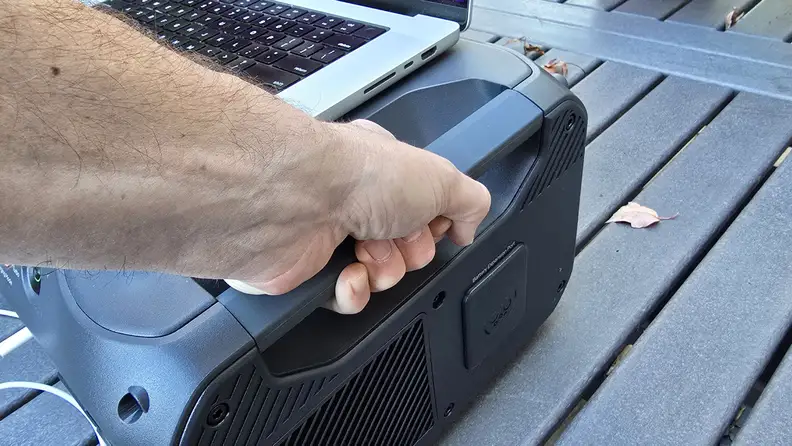
A sturdy handle helps, but this power station is meant to be placed, not hauled around all day.
While the Apex 200 is billed as a portable power station, it's by no means lightweight. It has a squat shape that makes it easy to store and fit in various areas, but it's still over 50 pounds. If you want to charge it via solar panels and don't have a single spot to set it and forget it, then remember: Lift with your legs.
It's about 30 pounds lighter than Bluetti power stations with slightly more output, like the Apex 300, the next step up in the line. The handles are great and sturdy, making it less of a chore to carry around than it might be.
The Apex 200 isn't water-resistant. It feels like a durable, outdoor-ready device (and the Sora 500W solar panels are IP67 rated), but the power station itself can't keep water or dust out, so keep it away from damp or dusty environments if you want it to last.
It lacks the 240V output some users will want
The main difference between the Apex 200 and the older Apex 300, which costs a bit more, is the lack of 240V output—the Apex 300 has a NEMA 14-50R outlet with 120/240V split-phase power. Typically, 240V-powered appliances have large heating elements, such as electric ovens, dryers, heaters, and water heaters. Most home HVAC systems and well pumps also demand 240V, though even a fully kitted-out Apex 300 with backups may not start a home AC on its own.
If your RV, camper, or home demands that higher voltage, the Apex 300 is the way to go. They're similar and just as expandable, though you give up some of the newer features on the Apex 200, like built-in USB ports and smart control over four 120V outlets through the app.
For a whole-home backup system that can last for days, you may want to look elsewhere
While the Apex 200 excels when you want efficient, electric backup power, many people care about keeping everything on during a grid outage. A portable camper van or RV may use only 1–5kWh per day, but a larger three- or four-bedroom home will use closer to 30–40kWh per day—especially if you have HVAC running. While you can configure the Apex 200 to handle that much, recharging it regularly is more difficult than refueling a propane-powered backup generator.
Warranty
Bluetti's warranty policy page lays out the terms. At launch, it's unclear exactly how long the Apex 200's warranty lasts, but if it matches the Apex 300's, it will carry a five-year manufacturer's warranty under those same terms.
Should you buy the Bluetti Apex 200 Power Station?
Yes, if you want a portable, expandable power solution for camping, tailgates, and the occasional power outage
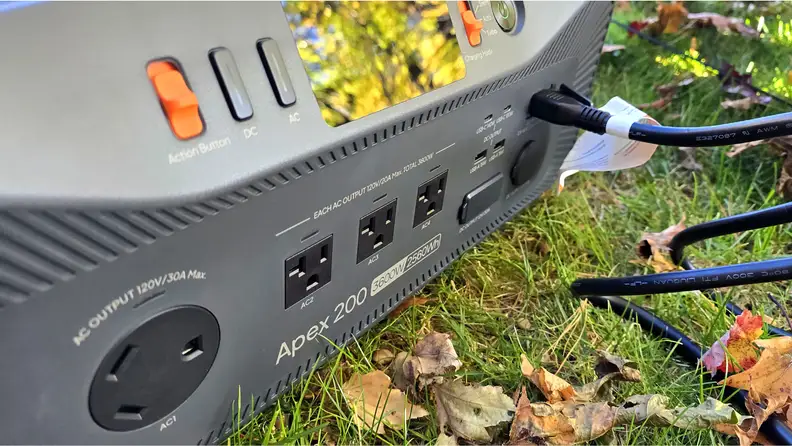
A wide mix of AC, USB, and 12V outlets gives the Apex 200 the versatility to cover home backup and weekend trips.
If you own a home, you inevitably need some backup power solution. There will come a time at 2 a.m., when you can least afford to deal with it, that the power will go out. Most people don't need a massive solution to get through—a simple backup power solution like the Apex 200 (available at Bluetti Power) is just right to keep your fridge running and electronics topped off for a day or so without having to run a cable to a gas generator a safe distance from your home.
And for people who want something more adventurous—from a tailgate or weekend camping trip to a full-blown #VanLife—the Apex 200 can adapt to almost any situation. The flexibility to charge it with solar, with an alternator-driven solution like Bluetti's Charger 1 or Charger 2, or by simply plugging it into the grid is a major advantage. And while the Apex 200 on its own has enough capacity for emergencies, you can combine it with up to six expansion batteries to store far more energy.
Though adding these accessories increases the cost, weight, and bulk of your setup, it's the flexibility and swappability that make it special. The closest comparison is the Apex 300, Bluetti's existing power station solution. The Apex 200 costs a bit less, offers USB ports out of the box, and includes updated smart control for four standard outlets, though it lacks 240V output. That might be a problem if you have certain HVAC components, well pumps, heat pumps, ovens, or water heaters you want to use this with, but for most household needs, including refrigerators, gadgets, and things that plug right into the wall, this will get you through just fine.
And that's the major upside here: It suits your needs. Need a small power station for occasional backups? This can do that, right out of the box. And with the right extras, it can do way more. Want to double the capacity? Sure thing. Want to triple it? Power it with solar? Plug it into your van, take off into the sunset, and live off the grid? This can be the central piece of a larger solution to get you there.
Related content

 feature

Meet the tester

TJ is the former Director of Content Development at Reviewed. He is a Massachusetts native and has covered electronics, cameras, TVs, smartphones, parenting, and more for Reviewed. He is from the self-styled "Cranberry Capitol of the World," which is, in fact, a real thing.
Checking our work.
Our team is here to help you buy the best stuff and love what you own. Our writers, editors, and experts obsess over the products we cover to make sure you're confident and satisfied. Have a different opinion about something we recommend? Email us and we'll compare notes.
Shoot us an email